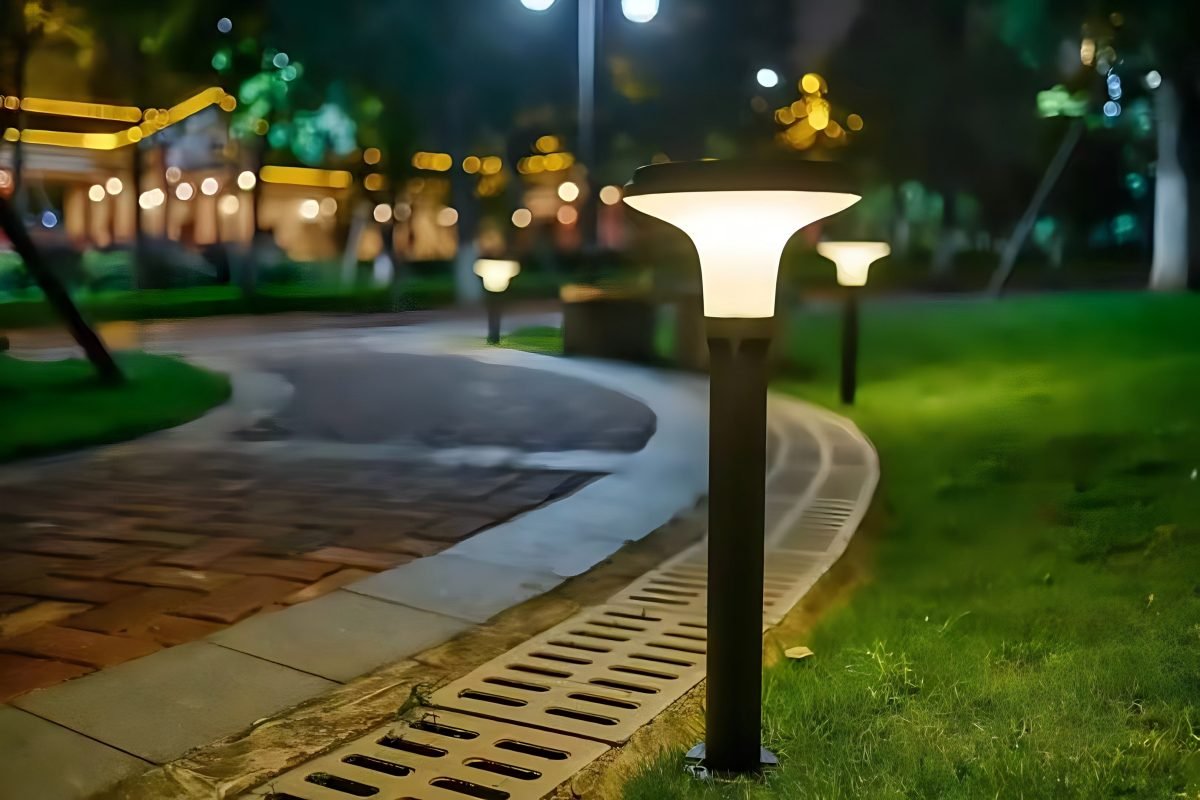
Proper solar street light sizing is essential for achieving stable lighting performance, longer battery life, and maximum energy efficiency. Below is a simplified calculation guide for selecting the right LED power, battery capacity, solar panel size, and pole configuration.
LED Wattage Selection
Choose LED wattage according to road type and lighting requirements:
| Residential Roads / Lanes | 20W–60W |
| Urban Main Roads | 80W–150W |
| Highways / Large Areas | 150W–250W |
Daily Energy Consumption Formula
E=P×HE=P\times HE=P×H
Where:
- E = Daily energy consumption (Wh)
- P = LED wattage (W)
- H = Night lighting hours (h)
Battery Capacity Calculation
Battery capacity should support 2–3 backup days for cloudy or rainy weather.
Cbattery=E×NηC_{battery}=\frac{E\times N}{\eta}Cbattery=ηE×N
Where:
- Cbattery = Required battery capacity (Wh)
- E = Daily energy consumption
- N = Backup days
- η = Battery discharge efficiency
Typical Battery Efficiency
- LiFePO4 Battery: η ≈ 0.8
- Lead-acid Battery: η ≈ 0.5
Solar Panel Size Calculation
Average effective sunlight hours are usually 4–6 per day, depending on location.
Psolar=EHsun×ηchargeP_{solar}=\frac{E}{H_{sun}\times\eta_{charge}}Psolar=Hsun×ηchargeE
Where:
- Psolar = Solar panel wattage (W)
- E = Daily energy demand
- Hsun = Peak sunlight hours
- ηcharge = Charging efficiency (0.75–0.85)
Pole Height and Pole Spacing
Proper pole spacing ensures uniform road illumination and lower installation costs.
| Residential Roads | 4–6 m | 20–30 m |
| Urban Main Roads | 8–12 m | 30–50 m |
| Highways / Large Roads | 12–18 m | 40–60 m |
Quick Solar Street Light Design Steps
- Select LED wattage based on road type.
- Calculate daily power consumption.
- Determine battery backup days.
- Size the battery system.
- Calculate solar panel wattage.
- Choose a suitable pole height and spacing.
- Add 10%–20% safety margin for stable performance.
Conclusion
Using the correct solar street light calculation method helps improve lighting efficiency, reduce maintenance costs, and extend system lifespan. For professional projects, local solar radiation data and lighting standards should also be considered.