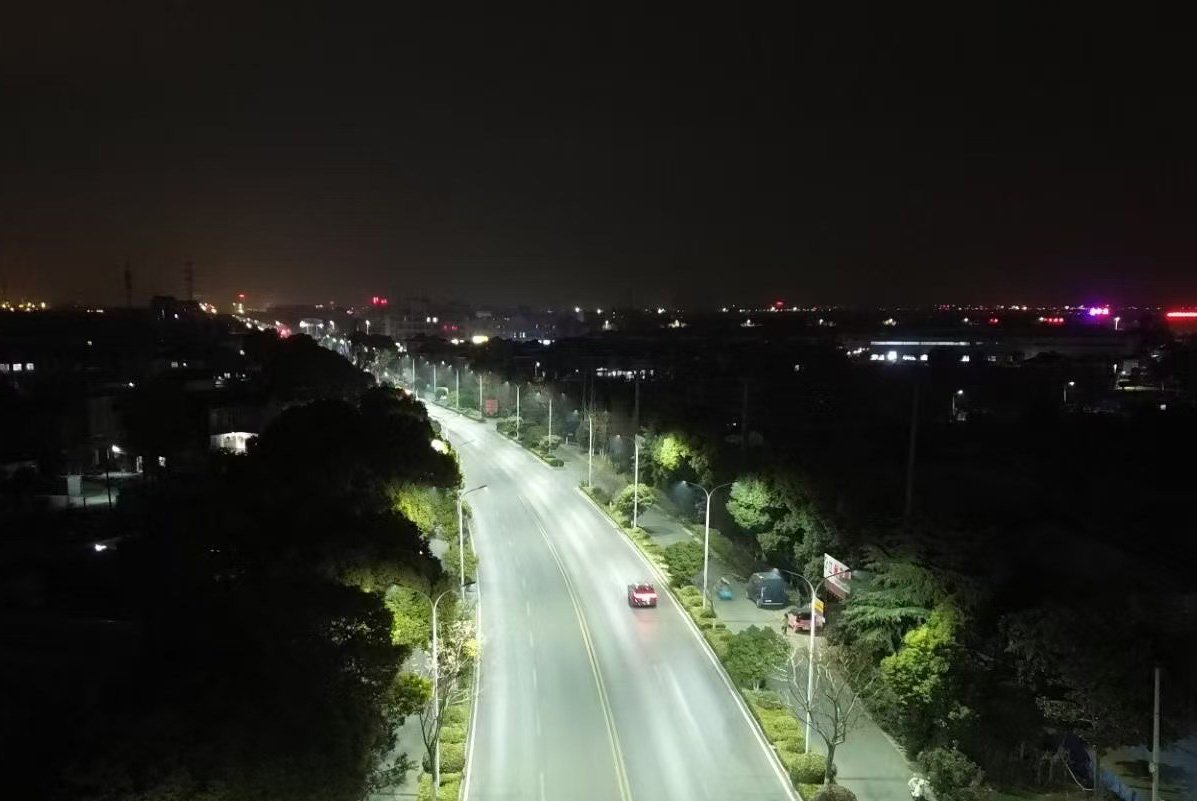
LED Street Light Components and Wattage Classification
LED street lights are typically composed of a high-quality aluminum alloy heat sink, a high-transmittance tempered glass cover, a high-efficiency LED light source, and an intelligent driver. Combined with a precision multilayer circuit layout and advanced thermal conduction technology, this design ensures long-term stable operation and significantly extends the luminaire’s service life.
Common LED street light wattages generally range from 20W to 200W, and are typically classified into the following five categories:
- Below 30W
- 30–80W
- 80–120W
- 120–200W
- Above 200W
Higher wattage delivers wider illumination coverage but also increases energy consumption and system cost. In practical applications, wattage selection should be based on required brightness, luminaire efficiency, road conditions, and installation environment.
Below 30W
Low-wattage LED street lights are ideal for sidewalks, parks, residential streets, and roads with low nighttime traffic. They provide sufficient basic safety lighting while minimizing light pollution and energy waste. The light output is soft and comfortable, and with proper lighting layout design, uniform illumination can be achieved to create a safe and pleasant nighttime environment.
30W–80W
This wattage range is suitable for urban secondary roads, branch roads, and commercial streets, where a balance between traffic safety and visual comfort is required. These luminaires deliver adequate illumination while effectively controlling glare and improving road visibility. When combined with smart dimming systems and optimized pole spacing, they achieve an excellent balance between energy efficiency and lighting performance. This range is widely used on city roads with moderate nighttime traffic as an efficient, energy-saving, and low-carbon lighting solution.
80W–120W
LED street lights in this range are commonly used on urban main roads and traffic hubs, where traffic volume is high and vehicle speeds are faster, requiring stricter standards for illuminance and uniformity. These luminaires offer high luminous efficacy and stable color temperature, significantly enhancing nighttime driving safety and visual comfort. With cut-off optical designs, stray light is minimized, helping to protect the surrounding lighting environment. They are widely applied on expressways, major intersections, and key public access routes, forming a core component of modern urban lighting systems.
120W–200W
Designed for highways, large plazas, interchanges, and extra-wide roads with high illuminance requirements, LED street lights in this range provide long-range light projection and strong environmental penetration. They ensure clear visibility for high-speed nighttime driving. When integrated with intelligent monitoring and remote-control systems, these luminaires enable on-demand lighting and dynamic energy management, reducing operational costs while maintaining safety. Their robust structural design ensures stable performance even under complex climatic conditions.
Above 200W
High-power LED street lights above 200W are suitable for tunnels, large industrial areas, and special elevated road sections where extremely high illuminance and operational stability are required. They deliver exceptional lighting coverage and output. Advanced thermal management systems ensure reliable operation in extreme weather conditions. Precision optical design reduces light scattering and energy loss while minimizing environmental impact. These luminaires are often integrated with smart management systems for remote control, real-time monitoring, and data feedback. In tunnel applications, they effectively reduce visual confinement and enhance driving comfort.
Practical Selection Recommendations
In real-world projects, wattage selection should be flexible and application-specific, taking into account road classification, surrounding environment, and operating hours. Local climate conditions and maintenance requirements should also be considered. Priority should be given to luminaires with high protection ratings and excellent thermal performance to extend service life and reduce maintenance frequency.
Future Outlook
With the continuous development of smart cities, LED street lights will be increasingly integrated into IoT systems, enabling real-time data feedback and precise lighting control. This integration will further promote urban lighting systems toward a green, intelligent, and sustainable future.