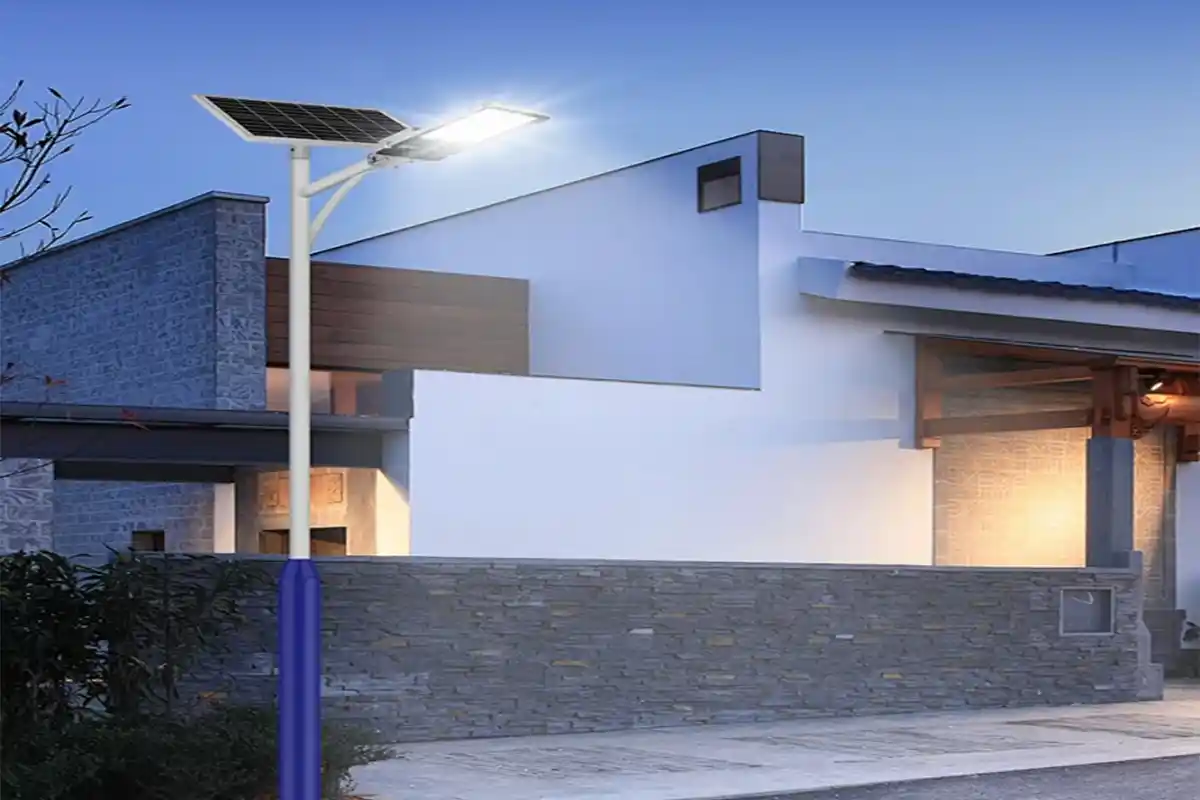
A solar street light typically consists of a solar panel, a battery, a controller, an LED light source, a lamp pole, and a foundation structure. The system collects solar energy during the daytime and stores electrical power, which is then used to provide stable lighting for the LED fixture at night or under low-light conditions. It features automatic on/off operation, intelligent dimming, and multiple safety protection functions. The entire system operates efficiently and is environmentally friendly without the need for a grid power connection, fully reflecting the integration of green energy technology with modern lighting concepts—echoing the principle of “adapting to local conditions and benefiting people through smart engineering.”
Solar Panel
The solar panel is the core power generation unit of a solar street light. It converts sunlight into electrical energy, which the controller optimizes and stores in the battery for efficient use. Solar panels are commonly made with monocrystalline or polycrystalline silicon cells, which utilize the photovoltaic effect of semiconductor materials to generate voltage and current with high conversion efficiency. Even under cloudy or low-light conditions, they can maintain relatively stable power output. The panel surface is typically treated to provide dustproof and waterproof protection, enabling reliable operation in various harsh weather conditions. The panel’s power rating directly determines the system’s energy generation capacity and charging efficiency, thereby affecting nighttime lighting duration and brightness.
Battery
The battery stores the electrical energy produced during daylight hours and plays a critical role in maintaining uninterrupted nighttime illumination. Most solar street lights currently use lithium iron phosphate (LiFePO₄) batteries or lithium batteries. LiFePO₄ batteries offer advantages such as long cycle life, high safety, and strong resistance to high temperatures, while lithium batteries are known for their high energy density, lightweight design, and fast charging and discharging performance. Given their long-term stability and outdoor application requirements, LiFePO₄ batteries are increasingly the mainstream choice for solar street light energy storage systems.
LED Light Fixture
The LED street light provides illumination for the solar street lighting system. It uses high-brightness, low-power semiconductor lighting technology and offers a long lifespan, fast response, and strong vibration resistance. Its luminous efficiency is significantly higher than that of traditional light sources. When combined with professional optical lenses and reflector designs, precise light distribution can be achieved, improving illumination uniformity while reducing light loss and energy waste. LED light sources operate stably under low-voltage DC power, making them highly compatible with solar power systems and eliminating the need for additional inverters, thereby further improving overall energy efficiency.
Controller
The controller acts as the “intelligent brain” of the solar street light system, coordinating energy management and operation timing among the solar panel, battery, and LED light. With built-in intelligent algorithms, the controller continuously monitors ambient light levels, battery capacity, and load conditions, automatically regulating charging and discharging processes to ensure stable operation even during extended cloudy or rainy periods. It also provides multiple protection functions, including overcharge, over-discharge, and short-circuit protection, effectively extending the service life of both the battery and the entire lighting system. Advanced systems may also support light control, time control, motion-sensing dimming, and remote monitoring for more refined energy management.
Lamp Pole and Foundation Structure
The lamp pole serves as the supporting structure of the solar street light and is typically made of high-strength steel or aluminum alloy. Its surface is treated with hot-dip galvanization and powder coating to provide excellent corrosion resistance, wind resistance, and weather durability, ensuring long-term performance in outdoor environments. The pole height and installation angle are designed based on road width, lighting requirements, and solar panel exposure conditions to maximize system stability and power generation efficiency. The foundation is usually fixed with poured concrete, with dimensions and embedment depth determined according to local geological and climatic conditions, ensuring safe and reliable long-term operation.