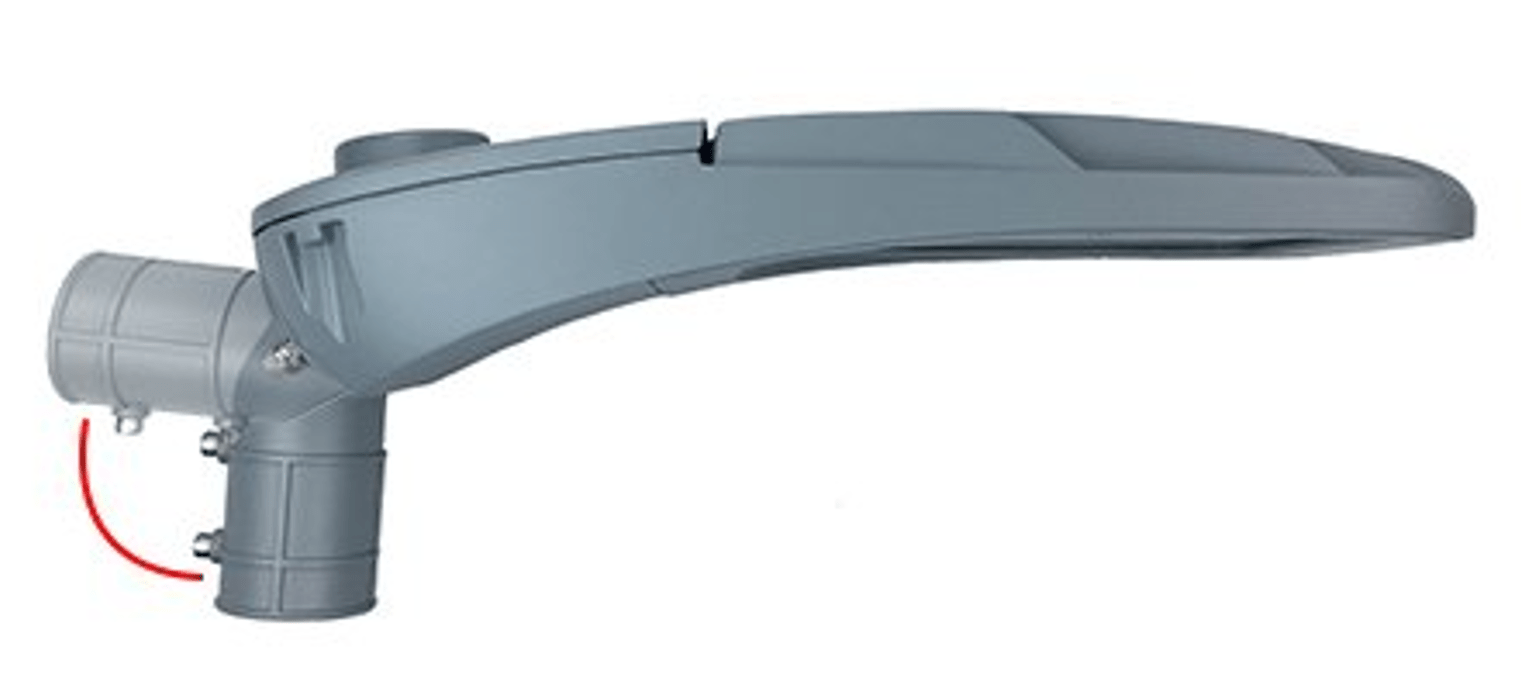
Streetlights are typically mounted on poles at an angle between 30 and 60 degrees, with the specific angle determined by design requirements and desired lighting effects. This angle must ensure sufficient illumination while preventing direct light from shining into drivers’ eyes or other sensitive areas. The choice of angle depends on various factors, including road width, traffic volume, and pedestrian needs. Selecting the appropriate mounting angle optimizes streetlight performance, improves road safety, and helps reduce light pollution and conserve energy.
fundamental structure
Light poles are predominantly constructed from steel or aluminum alloy, offering exceptional wind resistance and corrosion resistance. The lamp housings are typically made from high-strength die-cast aluminum and equipped with reflectors and lens systems to ensure precise light output. Components are interconnected via standardized flanges or clamps. The installation orientation of the lamps and the pole positioning must be precisely determined based on the road alignment and cross-sectional geometry, ensuring coordinated matching of lighting spacing and elevation angles. Straight sections should adopt symmetrical or staggered arrangements, while curved sections require directional adjustments to avoid lighting blind spots.
Angle range
The angle between streetlights and poles should be further refined based on road classification and functional zoning. For urban arterial roads, the angle should ideally be maintained between 45 and 60 degrees to optimize horizontal illumination distribution. Secondary roads and branch streets may adopt an adjusted angle of 30 to 45 degrees, balancing energy efficiency with lighting requirements. In pedestrian-dense areas, the upward angle should be reduced and light-blocking fixtures installed to minimize glare interference and enhance visual comfort.
influencing factor
Factors influencing streetlight installation angles include road width, traffic volume, surrounding building layouts, and greenery obstructions. Both the installation height and spacing of luminaires require careful consideration. Terrain undulations and water reflections on road surfaces may also affect light distribution, necessitating on-site surveys to adjust design parameters. The luminaires’ optical characteristics—such as light distribution curves, color temperature, and color rendering index—directly determine optimal projection angles. In foggy or rainy climates, reducing the elevation angle and enhancing beam concentration improve penetration. Additionally, differing visual requirements for pedestrians and vehicles at night require differentiated adjustment strategies for residential areas, commercial streets, and industrial zones.
road width
For wider roads, increase the lamp’s elevation angle or adopt a transversely symmetrical lighting arrangement to expand illumination coverage and ensure uniform lighting of the road surface. Narrow roads may moderately reduce the angle to prevent light spill beyond the road boundary and avoid light pollution. When installing lights on both sides, adjust the projection direction symmetrically around the road centerline to effectively overlap light spots on the pavement, minimizing brightness alternation. For asymmetric lighting needs, such as single-side lighting or mixed-function sections, adjust angles based on the gradient of road width variations to achieve a natural transition and a seamless lighting environment layout.
traffic flow
For high-traffic road sections, it is essential to enhance illumination levels and expand coverage areas to ensure driving safety. In low-traffic zones, reducing the elevation angle and narrowing the light beam can minimize energy consumption and light pollution. Main roads should adopt wide beam distribution modes during peak traffic periods to maintain horizontal uniformity. Branch roads and residential internal pathways may adjust projection directions based on pedestrian activity frequency, prioritizing illumination of sidewalks and intersection zones. At critical locations such as tunnel entrances, instantaneous lighting angles should be optimized to align with human eye adaptation curves to mitigate visual lag caused by abrupt light transitions.
surrounding environment
In high-density urban areas, dense clusters of tall buildings often create light-blocking effects. To compensate for insufficient street illumination, lighting fixtures should be adjusted in elevation while preventing glare from glass curtain wall reflections. Seasonal growth of greenery may obstruct sunlight, requiring dynamic adjustment of projection angles based on canopy height or the use of light-blocking fixtures. When near residential windows, strict control of upward light emission ratios is essential to minimize light disturbance. In historic districts and scenic roads, lighting designs must balance aesthetic harmony—precisely controlling light to highlight architectural silhouettes without compromising the visual purity of the night sky. All lighting environments require scientifically calibrated angles. For complex intersections, careful consideration of lane turns, pedestrian crossing paths, and traffic signal locations is crucial to optimize fixture placement and elevation angles, ensuring no critical areas remain unlit.
mounting height
Excessively high installation heights may cause glare diffusion and reduced road illumination, while insufficient heights can lead to glare and reduced coverage. For urban main roads, streetlights should be installed at 10-15 meters with appropriate elevation angles to ensure balanced horizontal and vertical illumination. In narrow streets, the height can be lowered to 8-10 meters to enhance localized lighting intensity. Height adjustments should be gradual to avoid abrupt changes in light. Under elevated bridges or interchanges, structural characteristics must be considered to reduce installation height and optimize the downward angle to prevent shadow obstruction.
Lamp spacing
Ensure continuous and uniform lighting. Main roads typically use 30-40 meter spacing with wide beam lamps to minimize light-dark zone transitions, while secondary roads and branch roads can adopt 20-30 meter spacing for enhanced local illumination stability. At curves, slopes, or intersections, increase lamp spacing and adjust projection directions to improve visual guidance. This approach achieves a balance between energy efficiency and safety.
Lamp parameters
Lamps with wider luminous flux curves can be installed at lower heights, while those with narrower curves require higher mounting heights to expand coverage. Therefore, the relationship between luminous flux and height should not be considered in isolation. A systematic approach must be adopted, taking into account both the actual road width and lighting requirements. The optical design of lamps should prioritize light-cutting performance, effectively control stray light, and enhance light utilization efficiency.
Actual Construction
During installation, a precision angle gauge must be used to ensure each lamp is positioned at the exact design angle, preventing lighting blind spots or overlapping halos caused by misalignment. Workers should conduct repeated angle checks and fine-tune the setup through nighttime testing to achieve even, continuous illumination. All lamp post parameters must be documented for future maintenance and management. Proper installation angles maximize streetlight efficiency by directing light precisely to critical road areas, reducing unnecessary illumination and light pollution while enhancing road safety. Flexible adjustments should be made during installation to optimize both visual comfort and energy efficiency, ensuring streetlights deliver maximum functionality.